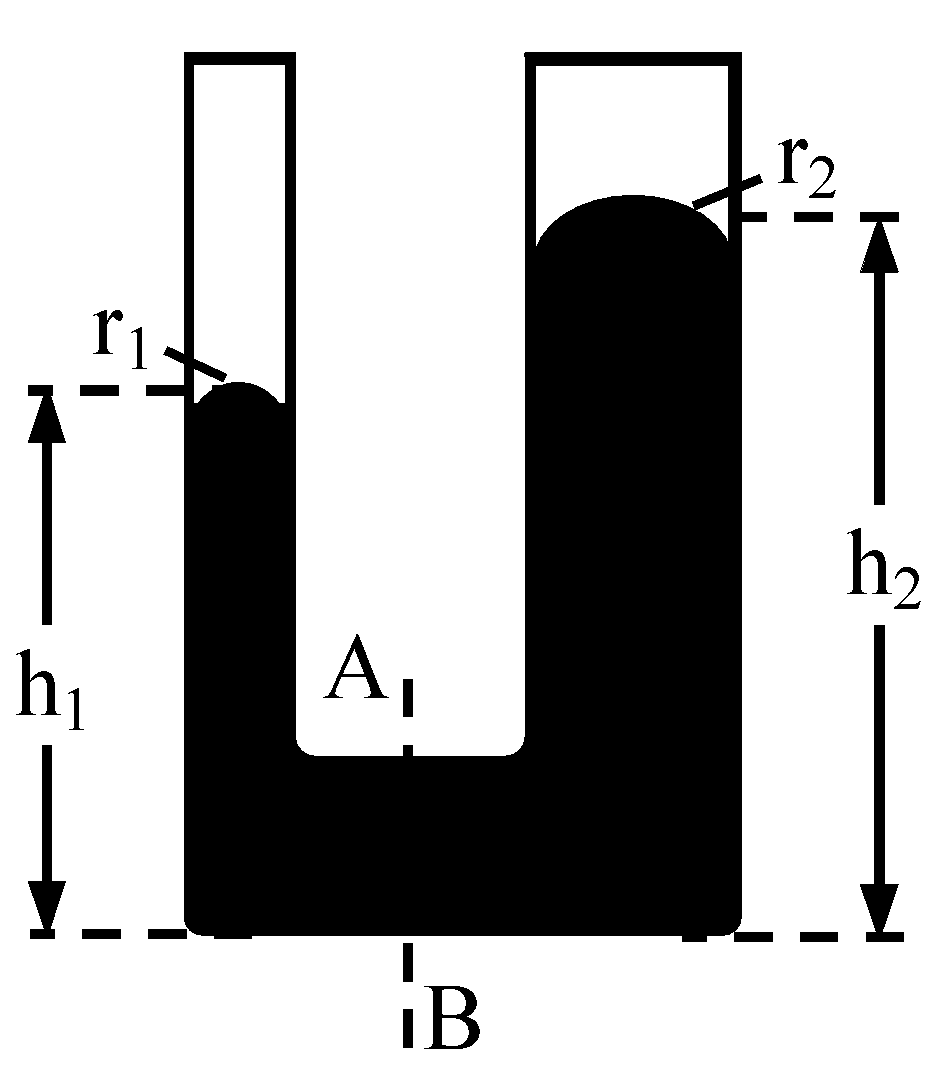
The internal radius of one limb of a capillary U-tube is r 1 = 1 mm and the internal radius of the second limb is r 2 = 2 mm. The tube is filled with some mercury, and one of the limbs is connected to a vacuum pump.
What will be the difference in air pressure when the mercury levels in both limbs are at the same height? Which limb of the tube should be connected to the pump? The surface tension of mercury is 480 dyn/cm.
Text Solution
Verified by ExpertsSol. The pump should be connected to the narrow capillary.
Let us denote the heights of the mercury levels before the air is pumped out by h 1 and h 2 .
The mercury in the tube will be in equilibrium if the pressures produced by the columns of mercury on the two sides are equal in the cross-section AB (Fig.). The total pressure in the cross-section AB is composed on each side of the pressure gh (mm Hg) created by the weight of the mercury column and the pressure produced by surface tension and equal to
 =
=  =
= 
For this reason the condition of equilibrium may be written as:
gh 1 +  = gh 2 +
or
h 1 – h 2 = 
 =
= 

The pressure difference of the air should compensate for this difference in the heights of the mercury columns, i.e., it should be equal (in mm Hg) to
 P = h 1 – h 2 =

 3.6 mm Hg.
Prepare Smarter with CGP Edu
Get practice questions, solutions, and test series in one place.
Write a Review
Share your experience with this question and solution.
Commentary
Send your comment, doubt, correction, or feedback to admin.
Similar Questions
Explore conceptually related problems